What did God Create?
Updated: Aug 6, 2025
What did God create; one tiny blue planet or the entire universe? I believe God created the universe by tuning the strings that establish the properties of the fundamental forces of the universe. They had to be tuned to perfection to enable atoms, molecules and life to exist.
Welcome to my blog on a Theory of God. Let me emphasis this is just what I believe. I am not asking anybody else to believe the theory. I am sharing it because I think others may find value in it and because I think it’s a paradigm that could bring peace.
There are seven sessions planned, so far;
1. An Introduction to the Theory of God
2. Where is God?
3. A look at our soul.
4. What did God Create?
5. Social Issues through the lens of the Theory of God.
6. How did I get here?
7. The Theory of God Hate-loss program.
In the first session, an introduction to my Theory of God was presented.
The second session covered ‘Where is God’. Considering; if God is present, why can’t we see God?
The third session took a look at the soul. From the perspective of the Theory of God, souls are not binary and through our choices, we are in control of it.
This session, the fourth session explores creation. What did God create; one blue planet, or a vast universe? Did God tune the strings that made it all work?
The fifth session explores social issues through the lens of the Theory of God.
The sixth session covers how I came up with the theory, and why I am sharing it now.
The seventh session will look at forms of love and hate to help steer us away from hateful behaviors.
I hope you find the theory compatible with your own beliefs and thought provoking. I’d love to hear what you think of the theory.
A Theory of God

I begin again with the disclaimer that this is ‘My’ Theory of God because it’s what ‘I’ believe. But I don’t own it. If you like the theory, it’s yours, too. I am NOT a religious scholar nor am I a saint. So, I am not sharing this theory from a position of authority or some moral higher ground. This is simply my paradigm of God, for your consideration.
I have, for the most part, kept my Theory of God to myself for the last 40+ years because it is my personal belief. I have chosen to share it now because I think there may be value in it for others and because I think it’s a paradigm that could bring peace.
The theory is based on the premise that God is real. To me that means that God exists even if all the religious text did not. God does not exist because men wrote about God in ancient texts. The texts were written because God exists. Which is why my Theory of God had to be independent of the ancient texts.
To reiterate from previous sessions, the theory is that God is a sentient force in dimensions that overlap ours. In other words, God is here.
God seeks the senses of life and is the soul of life. ALL life.
No two souls are alike. It’s not ‘You have one or you don’t’. Souls vary in size and hue and change over the course of our life. Our life choices and our actions establish the size and hue of our own soul.
I believe there is symmetry in nature and that Evil, the symmetrical force of God, also exists.
The Benefits of the Theory of God

To reiterate the benefits of the theory; It emphasizes the common ground that all religions share. They share that common ground because God was present LONG before religions were established. If God, by any name, is the common ground of all religions, people should accept that different religions are just culturally different ways of connecting with God. One is not better than another. It’s just a different means to the same end. So, there should be mutual respect among various religions.
I believe my Theory of God is NOT in conflict with ANY of the world’s religions. As I see it, It can’t be. God, by name, is at the core of all religions.
I think the theory provides an understanding that enables anybody to build a closer relationship with God individually or through organized religion. I believe organized religions already teach and practice the behaviors that help people connect with God. But there are simple things that anyone can do every day that enables each of us to do our own part to make the world a better place.
It also gives a deeper appreciation for all life on earth. And I use the theory as the basis by which I assess contemporary social issues such as capital punishment and abortion, which will be considered further in the fifth session. It also has given me a new perspective on death.
To me, those are valuable benefits. So, despite my reticence to sharing my own personal beliefs, if there is ANY chance that this could make the world a better place, I feel obligated to share. So, my beliefs are offered here for your consideration. I hope you find the theory compatible with your beliefs and enlightening.
________________________________________________________________________
What did God create?

A single blue planet?
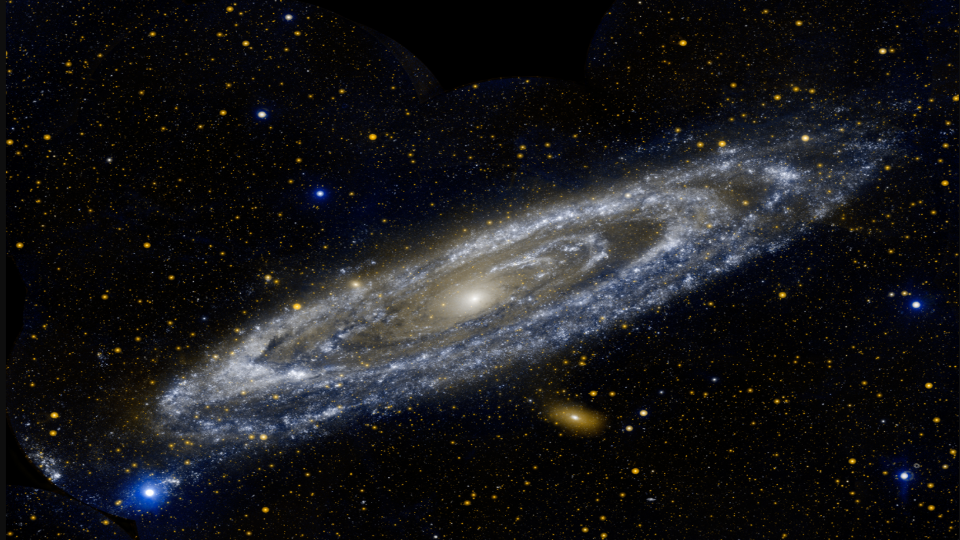
Or a vast and complex universe?
Ancient texts, such as the Bible, were written by scholars who ‘knew’ that our planet Earth was the center of the universe and claimed infallibility because they were ‘Men of God’. So, when Galileo suggested that the Earth rotates around the sun, the church was aghast, tried him for heresy and sentenced him to life in prison. Obviously, those scholars had limited knowledge about the universe and they were not infallible as they claimed. The sun does not rotate around the Earth, despite appearances. So, when I am contemplating God’s role in creation, I set aside the ancient texts and consider what Scientists have learned about the universe and the formation of life on Earth. I do not believe that Science and Religion are mutually exclusive. Why should they be?
I think that we (humans) can best understand our place in the universe, and God’s role in it, by considering the big picture; what have scientists learned, to date? In his book Sapiens: A Brief History of Humankind, Yuval Noah Harari pulled together a timeline of what we have learned about our universe and life on Earth. I found that the dates provided in Sapiens are in line with alternate scientific resources, so I have used them in the following discussion.

Based on what scientists have learned about the universe, the Big Bang occurred about 13.5 billion years ago. To give you a sense of how big the number 13.5 billion is, if you count one number every second, 24 hours a day, 7 days a week, 365 days per year without ever stopping to sleep, eat, or drink, it will take 428 years to reach 13.5 billion. It’s a REALLY big number, so big it is hard to comprehend how big it is. So, to give a sense of time scale that we can better comprehend, let’s consider 13.5 billion years as one year. The big bang occurred at the start of the first second of January 1st.
After the big bang, it took nearly 9 billion years of swirling dust to form stars and the Earth and nearly another billion for the very first organisms to leave traces of their existence on Earth. But those were just simple single cell organisms. It took another 4 billion years for more complex organisms with feeding, replicating and defensive traits to develop. Those traits led to an explosion of life, the Cambrian Explosion. In our compressed timeline, that explosion of life occurred in the very last month of the year, so let’s take a closer look at the last month.

During the last month of our compressed year, trilobites and other marine life thrived for a couple hundred million years until the Devonian extinction killed off 75% of the life on Earth. That extinction might have occurred because plants developed the ability to live on land. Life was good for another 120 million years, when a super volcano blew and poisoned the atmosphere and oceans. 96% of life was destroyed during that extinction event. After that, life came back and went on for another 50 million years before another extinction event took out 80% of life on Earth. The first vertebrates appeared after that extinction event and dinosaurs developed and flourished for the next 134 million years. But then a massive asteroid hit the Earth, possibly triggering volcanic activity. The ash and dust blocked out the sun for a couple of years killing off vegetation globally and ending the age of the dinosaurs. That enabled the rise of mammals. No humans, yet. That doesn’t come until the very last day of the year, so let’s take a look at the last day to see where humans appear on the scene.

Once the dinosaurs were gone, mammals flourished and evolved for tens of millions of years. A wide variety of animals evolved to capitalize on whatever niche environment that could be exploited. Many species evolved and went extinct during that time. The last common ancestor of humans and chimpanzees appeared roughly 6 million years ago, but it was another 3 and a half million years before the first homo genus animal appeared. These were not Homo sapiens. They were predecessors such as Homo neanderthalensis, Homo erectus, Homo habilis, and others. Neanderthals did not appear until 500,000 years ago. That is in the last hour of the final day of the year of our compressed timeline and still no Homo sapiens. So, lets take a closer look at the final hour of the year.

Neanderthals and other Homo species, which I’ll call humans, flourished and spread for a couple hundred thousand of years throughout Africa, Europe, Asia and Australia. Then, about 300,000 years ago, humans started using fire to cook their food. That was a game changer. The body no longer needed as much time and energy to digest food. In time, like 100,000 years, human bodies evolved. Their digestive system no longer required a massive amount of blood flow. Instead, it could support development of bigger brains, which increased their chance of survival. That led to the appearance of the first Homo sapiens about 200,000 years ago. Humans were still hunter-gatherers but we were getting smarter and learning to work together. It wasn’t until about 70,000 years ago that we can find evidence that humans had developed fictive language. 30,000 years later, almost the very last minute of our compressed timeline, Neanderthals were wiped out. Homo sapiens became the last surviving animal from the Homo genus. Let’s take a closer look at the very last minute of the final day of our compressed year to get closer to a time frame that we can relate to.

For nearly 190,000 years, Homo sapiens were hunter-gatherers, but then about 12,000 years ago somebody got the bright idea that they could plant seeds and capture animals and they wouldn’t have to go out hunting and gathering anymore. They could raise their food wherever it was most convenient. More food, less risk, the ability to build a permanent shelter; the Agricultural Revolution was a hit. It wouldn’t take long until villages were established and then, about 5,000 years ago, the first kingdoms appeared, along with script and coins.
Let’s have a time check, here. We’re just 12 seconds from the end of our compressed year and we’re just now reaching the point where Homo sapiens have advanced beyond simple hunting and gathering. For the first time, humans live in cities and have developed script and money. Civilization. None of today’s religions had been established, yet, and won’t be for a couple thousand years. Buddhism, Christianity, & Islam didn’t come about until 5 seconds before midnight.
And still we haven’t gotten to modern times, so let’s take a closer look at the very last second of the year.

Ah. At last. In the last half of the last second, we reach the Industrial Revolution. The beginning of modern times. The end of using animals for transportation and plowing fields.
In the last half of the last second, we reach the beginning of modern times…. We just got here. Dinosaurs roamed the Earth for more than 100 million years or 60 hours on our compressed timeline. Homo sapiens has been around less 8 minutes. And modern times, the last 200 years, is just the last half of a second. We are just a flash in the pan compared to the realm of the dinosaurs. For our own good, we should be cognizant of our place in the universe.
Let’s go back to the final minute to reconsider what God created.

What did God create?
Do we have to go back to when Homo sapiens first appeared?

Or do we need to go back to when all of God’s creatures were created?

But that leaves out all the trilobites and dinosaurs, so we have to go back a little further.

And that leaves out the creation of the Earth, so we have to go back even further.

But did God create one blue planet, or the entire universe?

I believe God created the universe. And I think that was no simple task. This was not just BOOM and matter swirled about for billions of years forming stars and planets. It took something far more miraculous than that.
The 4 fundamental forces; gravity, electromagnetism, the weak nuclear force and the strong nuclear force, had to have precisely the right balance of strength and effective distance properties in order for atoms to form. Without atoms, there could be no molecules. Without molecules there could be no life.
String Theory proposes that the 4 fundamental forces are the result of vibrations of the smallest particles: strings. Not random vibrations, but harmonic vibration, which is dependent on the length of the string. This is why creating a universe is so amazing. The strings that form matter and energy had to be tuned just right for anything to form. Atoms, molecules, and life were all dependent on those strings being precisely tuned.
A closer look shows why the balance of the fundamental forces had to be exactly right for life to exist. The details get into physics, chemistry and organic chemistry, but only at a very basic level. But if this stuff makes your head spin, it’s not important. What is important, to me anyway, is that the deeper you look, the more amazing it is. But if you are interested in learning more, to better understand just how impressive creation is from a scientific paradigm, read on. It is truly amazing. Hopefully, this won’t make your head spin.
Start with the four fundamental forces and their properties.

The strong force is the force that holds protons together in the nucleus of atoms. It has very limited range: the width of an atomic nucleus. The electromagnetic force causes objects of like charge to repel each other and opposite charges to attract. The weak force causes atomic decay and gravity causes mass to be attracted any other mass.
As an example of how the forces interact, consider the oxygen atom. The nucleus contains eight protons and eight neutrons. The protons all have a positive charge so the electromagnetic force wants to separate them, but the strong force holds them together because it is 137 times stronger than the electromagnetic force. Fortunately, the range of the strong force is limited to the diameter of the atomic nuclei. If the strong force had the effective range of gravity all matter would get sucked in and atoms and molecules could never form. But it is not. It is perfect. It’s just enough to hold a nucleus together to attract electrons.

Since the eight protons in nucleus of oxygen has a +8 charge, it attracts eight electrons. The electrons want to stay away from each other though, due to the electromagnetic force. Only two can get close to the nucleus. If there was a third electron in close they would be too close together. The electromagnetic force would push them apart. So only two electrons can fit in the inner orbit. The second layer of electrons can have up to eight electrons until it is too crowded, but oxygen only needs six more electrons to balance out the eight protons in the nucleus, so it has six.
The same principles apply to every element. If all the elements are organized by the number of protons in the nucleus and number of electrons in the outer most shell we get the periodic chart of elements.

The number of electrons in the outer shell determines how an element reacts with other elements. If it’s an element with a full outer shell, like neon, helium and argon (on the right side of the table), it doesn’t react with much of anything. On the other hand, if there is room in the outer shell for more electrons it is more likely to interact with other atoms. Consider hydrogen. It has one proton and one electron in its outer shell.

Hydrogen and oxygen naturally connect because they can share electrons in their outer orbit. It’s called covalent bonding. If two hydrogen atoms share an electron with an oxygen molecule, the oxygen atom’s outer electron shell is filled to eight and the hydrogen’s outer shell is filled to two. It’s a very stable configuration, which is why we have so much water: H2O.

Because the electromagnetic force works to keep electrons away from each other, hydrogen always connects to oxygen in exactly the same way resulting in a 104.5 degree angle between the hydrogen atoms. This results in each water molecule having a polarity; the oxygen end of the molecule is slightly negatively charged and the hydrogen side is slightly positive. It is this structure and polarity that cause snowflakes to always have six arms.

The structure and polarity are also the reason why water is such a good solvent. Water is attracted to either positively or negatively charge atoms. That is why water is able to carve solid rock into caves and canyons. Water can carry away minerals one atom at a time for millenia. But water wouldn’t have the same structure, polarity or properties if the balance of the four fundamental forces were even slightly different. They had to be perfect.

But the water molecule is a very simple molecule. And while the structure and polarity of a water molecule reflect the balance of the fundamental forces, it does not demonstrate the beauty of covalent bonding and how covalent bonds enable life. For that we need to look at more complex molecular structures such as ADP and ATP and the process of cellular respiration which fuels every form of life on Earth, in both plants and animals.
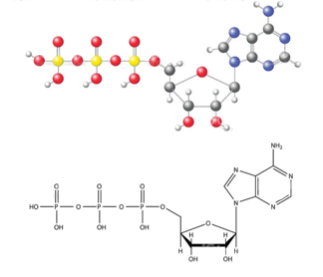
When ATP is carried into cells the last phosphate group (on the left end of the chain in the illustration above) is broken off converting ATP into ADP. In the process of breaking the bond between the second phosphate group, energy is released which is then available for use by the cells.

ADP can then be recharged with another phosphate group to form ATP again by using the energy from the breakdown of molecules of food that we eat. If the bonds were too strong or too weak, the ATP-ADP cycle could not carry energy to our cells. The balance of the four fundamental forces has to be perfect for this process to work. For more details about ATP-ADP check out Cellular Respiration on KahnAcademy.org.
Consider another, more familiar example. Red blood cells carry oxygen to our cells and carbon dioxide away from them. Hemoglobin in our red blood cells contain iron atoms to which oxygen adheres to loosely when there is an abundance of oxygen present, such as in our lungs. When the hemoglobin is carried to parts of our bodies where oxygen is deficient, the oxygen is released and can be used by our cells. Once again, the strength of the fundamental forces is key. If the bond between the oxygen atom and the iron atom was too strong, the oxygen would not be released to our cells that need it.
In conclusion, I believe God created the universe, not just Earth. God tuned the strings to balance the fundamental forces of nature to enable the universe and life to develop. The balance of forces had to be perfect. I believe, Homo sapiens is just the latest form of life on our little blue planet Earth. The finest form yet. It took 13.5 billion years to get here, which may seem like forever to us, but that may be just another day in the life of God. If we learn to live in harmony with each other and the planet we could be around for as long as the dinosaurs were. Maybe we can even create heaven on Earth. But if we can’t live in harmony with each other and the planet, we could be nothing more than a blip in the cosmic record. A species that came and went in the blink of an eye. Either way, God will remain. And if homo sapiens cannot learn to live in harmony with each other and our planet, perhaps the next species can do a better job of it.
This is why I see no conflict between science and religion. It seems to me that they fit together quite nicely. What do you think?
The next session will look at how I apply the Theory of God to contemporary social issues.


Comments